Posts

Showing posts with the label India

Beyond The Frame | Khanqah of Shah Hamdan (Kashmir) | X-Pro1
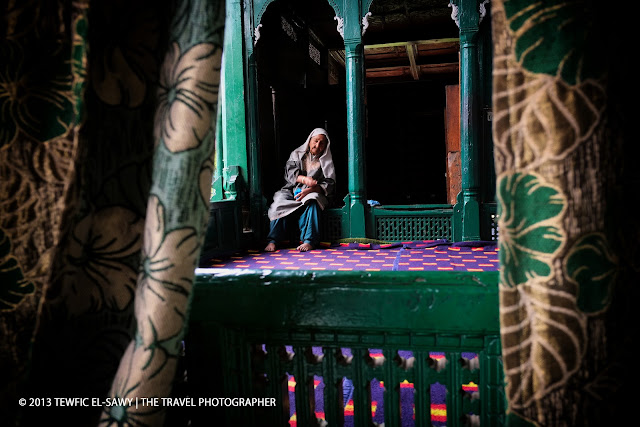
Image
Photo � Tewfic El-Sawy | All Rights Reserved Amir Khusrow Dehlavi (1253 � 1325 )  was a Sufi musician, poet and scholar from the Indian subcontinent, who was quoted as saying of Kashmir: �If there is a heaven on earth, it's here, it's here. (� Gar firdaus bar-rue zamin ast, hami asto, hamin asto, hamin asto. �) It is also said that it was Emperor Jehangir who said these words...whoever said it (and my money is on Khusrow), Kashmir is indeed beautiful. I'll set aside political views on the current (and recent) political events in Kashmir, and dwell on its beauty and spirituality....and its photographic magnetism. Historians are united that Hazrat Bulbul Shah was the first saint who sowed the seeds of Islam in Kashmir in 1301, and he might have come from Samarkand or from Bukhara. It was he who convinced Rinchan, the then ruler of Kashmir to convert to Islam, and Sadruddin Shah (as he became known) was the first Muslim ruler of Kashmir. He ruled Kashmir from 1320 to 13...
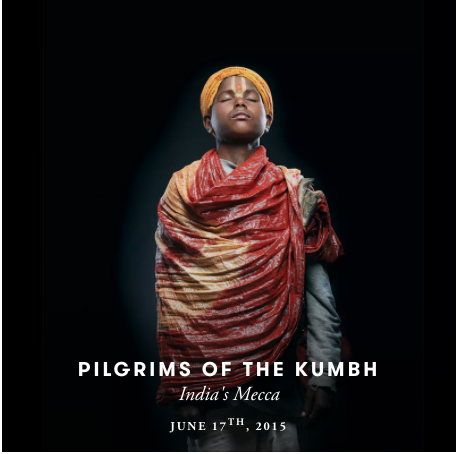
Justin Hession | Pilgrims of the Kumbh

Image
Photo � Justin Hession | All Rights Reserved Enough already with China, I heard you say? Well, here's a post on the famed Kumbh Mela in Allahabad in India. There are different kinds of Kumbh Melas...the so-called "Maha Kumbh" melas are the largest  kahunas of these Hindu religious festivals, and the second* Maha Kumbh of this century at Allahabad (also known as Prayag by observant Hindus) concluded with a magnificent ritual bathing on the occasion of Mahashivratri on March 10, 2013...and it is this religious gathering which influenced photographer Justin Hession to publish his stunning  Pilgrims of the Kumbh  portraits on Exposure.  Justin tells us he spent two weeks in a makeshift tent studio, making portraits of pilgrims drawn to these rivers' confluence. He chose a different perspective from the hundreds of photojournalists who came there to document the event, and opted to create studio style portraits against a plain black backdrop.  The Ku...

Terri Gold | Still Points In A Turning World Exhibition

Image
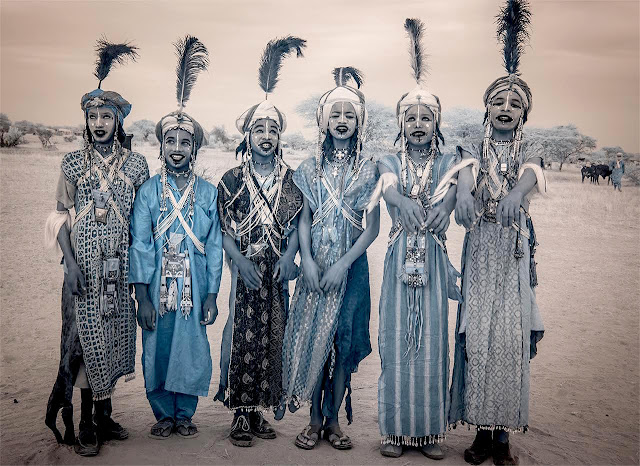
Photo � Terri Gold - All Rights Reserved Terri Gold is an award-winning photographer and artist based in New York City, and has built an impressive reputation for her infrared imagery of rituals, rites of passage, festivals, celebrations and portraits from all over the world.  Her work �Still Points in a Turning World,� is a life-long series of images exploring our universal cross-cultural truths: the importance of family, community, ritual and the amazing diversity of its expression. The images are from Niger, Namibia, Ethiopia, Kenya, and China & India, and will be shown at a forthcoming exhibition here in New York City:  It's one of many well deserved recognition of her talent and energy, and of her unwavering commitment to her craft. Her work has garnered many awards, is shown in galleries internationally and has been published extensively. Recent exhibitions of her work have taken place in Spain, San Francisco, Los Angeles, New York City, Colorado, Vermont and a...

Leonid Plotkin | The Bauls, Men of Heart

Image
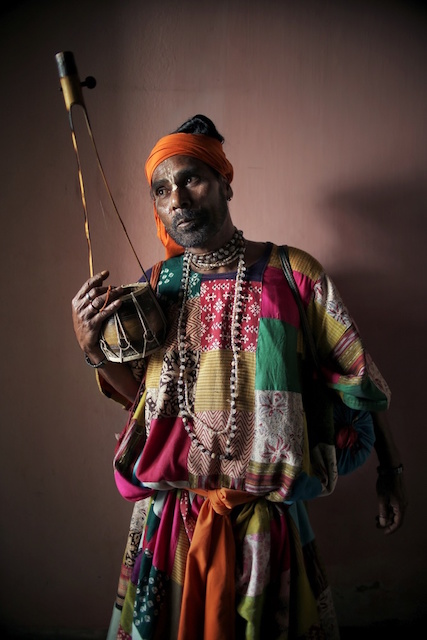
Photo � Leonid Plotkin | All Rights Reserved I've lost count as to how many times I have featured Leonid Plotkin's work on The Travel Photographer blog.  His latest work is Men of Hear t , and is on the Bauls who are a group of mystic minstrels from Bengal (Indian State and Bangladesh). The Bauls are members of a syncretic religious sect, and a follow a distinct musical tradition. A very heterogeneous group, with many sects, but their membership mainly consists of Vaishnava Hindus and Sufi Muslims. They are often identified by their distinctive clothes and musical instruments.  Baul music celebrates heavenly love, but does this in very earthy terms, as in declarations of love by the Baul for his female partner. Baul devotional music also transcends religion and some of its famed composers criticized the superficiality of religious divisions. The music of the Bauls and its lyrics carry influences of the Hindu bhakti movements and a form of Sufi song exemplified ...

In The Courtyard of The Beloved

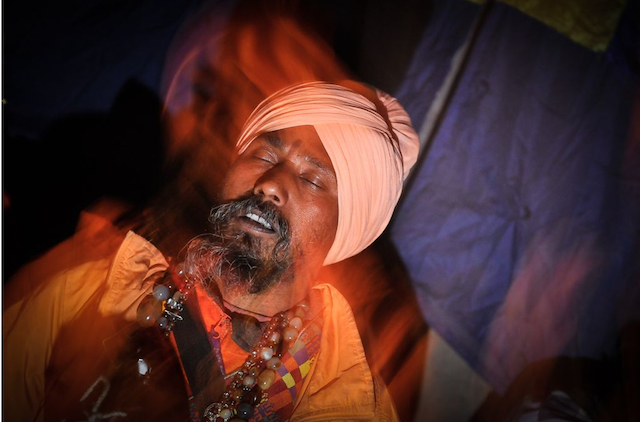
IN THE COURTYARD OF THE BELOVED by Tewfic El-Sawy on Exposure Ms Fatima Bhutto, daughter of Benazir Bhutto, recently wrote an  Op-Ed  in The New York Times bemoaning the gruesome event of an attack by the so-called "Islamic State" on a Sufi shrine in Pakistan, and described the Sehwan shrine as "...  an egalitarian oasis formed by the legacies and practice of Islam, Hinduism and Buddhism merging into one. "  The shrine of Moin'Uddin Chisti is another. Over the course of about a week, I photographed -virtually non-stop- at this shrine during the annual Urs (commemoration of death anniversary) of the Sufi saint Moin'Uddin Chisti. The shrine is in Ajmer, Rajasthan (India) and hosts one of the largest Muslim pilgrimages in the world.  It was most certainly one of my three most intense photographic experiences.  The 'ecosystem' feeding off the shrine consists of pious pilgrims, vagabonds and charlatans, sightseers, mendicants and beggars, fakirs, sho...

Shankar Subramanian | Hornbill Festival - Nagaland

Image
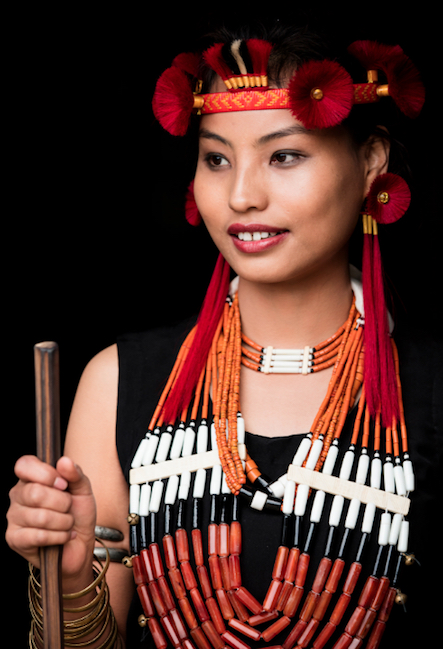
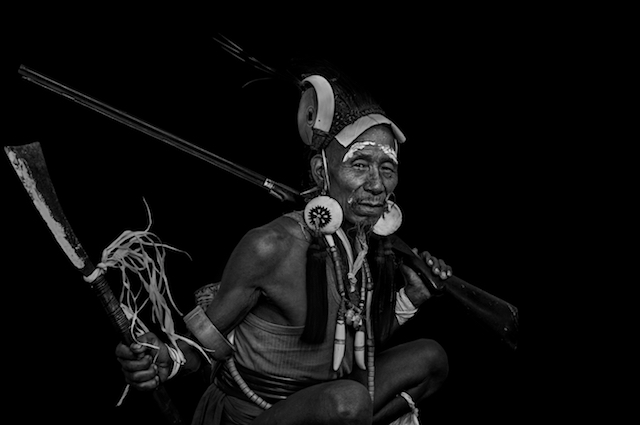
Photo �  Shankar Subramanian - All Rights Reserved I may consider myself as an old hand in India, but I cannot justify the reason for not having been to its "seven sisters" yet. The Seven Sister States are India's contiguous states of Arunachal Pradesh, Assam, Meghalaya, Manipur, Mizoram, Nagaland and Tripura in northeastern India...and this is a huge blot on my record. One of Nagaland's most attractive festivals is the Hornbill Festival, named after the bird, and which is one of the largest celebrations of its indigenous warrior tribes, who live in India's far north east region. The hornbill bird is particularly revered by the Nagas and is reflected in tribal folklore, dances and songs. The festival is organized by the state government and is attended by all of Nagaland's major tribes. It features traditional arts, dances, folk songs, and games. So it's with pleasure that I feature Shankar Subramanian's Hornbill Festival photo gallery. He has photog...

Mattia Passarini | Inked Faces

Image
Photo � Mattia Passarini - All Rights Reserved The word tattoo is derived from the Tahitian "tatu" which means "to mark something." It is claimed that tattooing has existed since 12,000 years BC, and its purpose has varied from culture to culture and from era to era. The recent tattoo popularity in the Western world most probably has its origins in Egypt during the time of the construction of the great pyramids. When the Egyptians expanded their empire, the art of tattooing spread as well. The civilizations of Crete, Greece, Persia, and Arabia picked up and expanded the art form, and China joined in around 2000 BC.*  Inked Faces by Mattia Passarini is a gallery featuring various tribal individuals sporting intricate tattoos. I found the most extreme to be the Ramnami of Chhattisgarh who tattoo the word "Ram" on their whole bodies. Also included are the Konya, the Khonds, the Baga, the Apatani; all from the far reaches of India. The Chin of Burma, the Li a...

Souvid Datta | India's Fading Musical Tribes

Image
Photo � Souvid Datta - All Rights Reserved One easily falls head over heels for India. No question about it. It happened to me in 1998, and I've traveled to its four corners (with some exceptions) over 20 times, imbibing its people, sights, smells, cultures, music and everything in between. It's well known for its diversity, various physiognomies, languages, religions, traditions and cultures. Across the country�s 29 states, over 500 dialects are spoken, over 800 million reside in booming metropolises, and its rural enclaves are home to over 2000 tribes. However modernity and globalization exact a price on all nations; especially those with traditions and cultures as deep as those of India. And may well cause the disappearance of its tribes, cultural practices and musicians. For example, the dancing Veerghase troops of Karnataka, the formidable hunting tribes of Nagaland, the revered Kawaili singers of Rajasthan: these groups, once essential and symbolic of their regions, may n...

Nhi Dang | Dreams Of Myanmar

Image
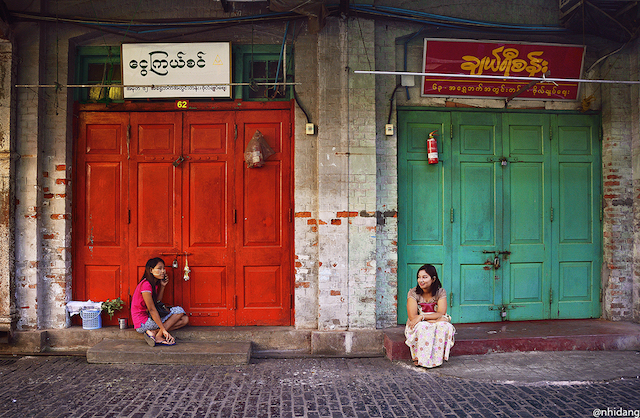
Myanmar, or Burma (as I occasionally prefer to call it) is a wonderful country which I had the pleasure of traveling in some time before its recent "modernization". Its people consist of a mix of settlers and invaders from all sides; the Mon and the Pyu are thought to have come from India, while the now dominant Bamar migrated through Tibet, and by the year 849, had founded a powerful kingdom centered in Bagan.  For the next millennium, the Burmese empire grew through conquests in Thailand and in India, then shrank under attacks from China and due to internal rebellions. Photo � Nhi Dang-All Rights Reserved I am often on the look out for young talented travel photographers to feature on this blog, and, because of my own background, I'm especially partial to those who left the "comfort" of a corporate career for a life of creativity, travel and cultural affinity. My current feature is about such an individual; Nhi Dang who describes herself as a videog...

Trupal Pandya | The Last Headhunters

Image
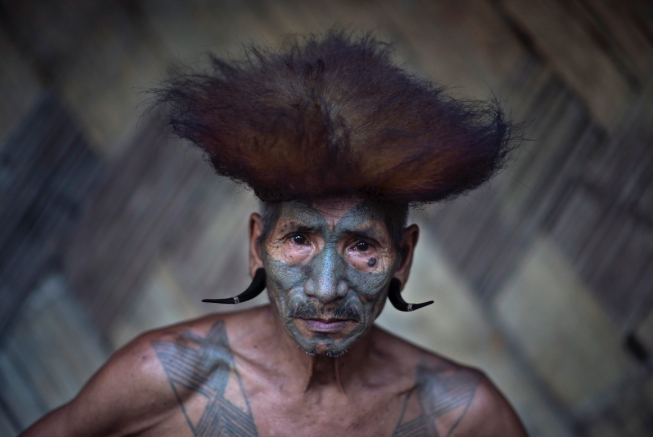
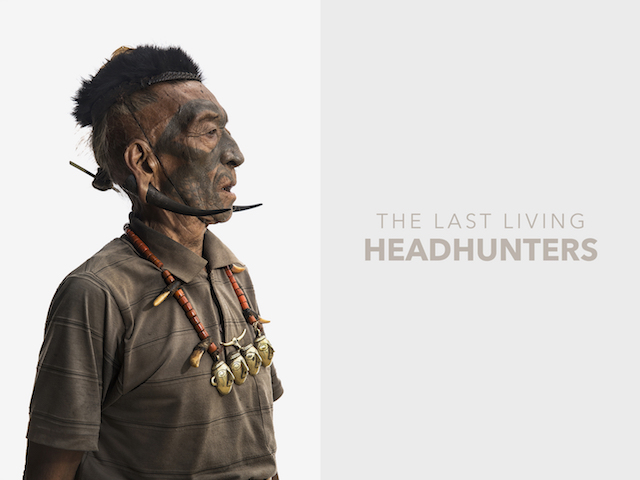
Photo � Trupal Pandya - All Rights Reserved The Konyaks are found in Myanmar, in a couple of districts of India's Arunachal and Nagaland, India. They are known in Arunachal as Wancho Konyak. In Nagaland, there are sixteen major indigenous tribes with different cultures and traditions. The most fascinating of these tribes are the Konyaks; the largest in number, identifiable by their tattooed faces and a history of fierce headhunting. Headhunting was important place in the Konyaks' tradition and culture. For the Konyak, killing an enemy and bringing back the head used to be considered a rite?? of passage, and was rewarded with a tattoo on the face or chest of the warrior. The more tattoos the fiercer (and more respected and feared) was the warrior. During the 1970's, the Konyaks converted to Christianity and consequently many ?traditional practices and rituals have vanished. What now remains are? ?a few old men with faded tattoos.These men are idling about certain villages, s...

Leonid Plotkin | Mysterium Tremendum

Image
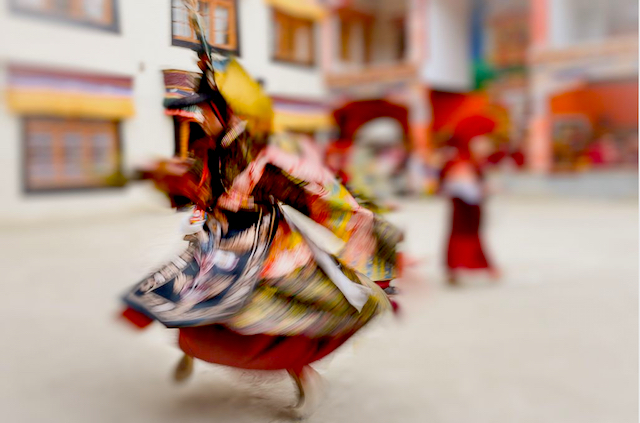
Photo � Leonid Plotkin - All Rights Reserved " Mysterium tremendum et fascinans"   Mysterium Tremendum is a Latin phrase meaning fearful mystery, which was coined by Rudolf Otto who is best known for his analysis of the experience that, in his view, underlies all religion. This is how Leonid Plotkin -a photographer whose work I've featured a number of times on this blog- titled his photo essay of Buddhist rituals and of ceremonial dances made in the remote regions of Ladakh and Zanskar. Some of the photographs are of Cham dances; the masked and costumed ceremonial performances associated with Tibetan Buddhism performed during Buddhist festivals. These dances are accompanied by music played by monks using traditional Tibetan instruments. The dances offer moral instruction relating to compassion, for good to defeat evil and bring merit to the performers and the audience. Leonid Plotkin is a freelance documentary photographer and writer. His work has appeared in publicatio...

Takehiko Yagi | Holi

Image
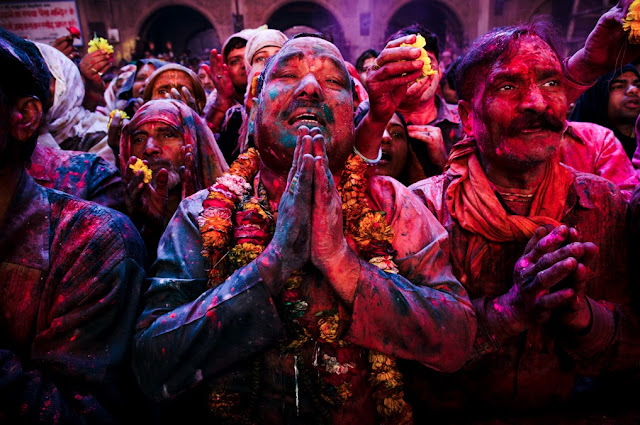
Photo �  Takehiko Yagi -All Rights Reserved "I have been fascinated by the colors of the sacred festival of Holi for nine years now. I fell in love with the festival for the first time when I saw it on television as a high school student."  This is very possibly a first.  My Twitter feed has the link to the photo gallery  Diving Into The Colors of Holi by Japanese photographer Takehiko Yagi, and naturally I followed it to view it. Scrolling down the intensely colored images of the well known Indian festival, I stopped at the above photograph, showing the spiritual intensity on the faces of devotees in the temple of Banke Bihari in Vrindavan, the epicenter of the Holi festival.  I recognized this exact scene because I was there as well....at the same time, and photographed these very same devotees. And then I remembered being shoulder to shoulder with an Asian photographer, who, now I know, was Takehiko Yagi. We were both swathed in scarves and eye protecti...

Udit Kulshrestha | The Nocte People

Image
Photo � Udit Kulshrestha _ All Rights Reserved The Nocte people, are an ex-headhunting lower hill tribe of the Patkai hills of eastern Arunachal Pradesh. They are ethnically related to the Konyak Nagas, and are originally from the Hukong Valley in Myanmar, from where they migrated during the 1670s-1700s. They originally followed Theravada Buddhism and animism, but have adopted Hinduism since the 18th century. Many of them converted to Christianity by American missionaries whose objectives were to convert tribes in Myanmar and China. The Nocte society is divided into two groups, the chiefs and the commoners. Udit Kulshrestha has photographed the Noctes, and his monochromatic gallery is on his website .  An interview with him and on his Noctes work is also on The Wire , a web publication in Delhi. Udit is an Indian photographer whose primary focus is on subjects of culture and social issues. I have particularly admired his excellent work on the Nautch Girls of Sonepur , Sanskaa...

Barbara Colbert | Theyyam

Image
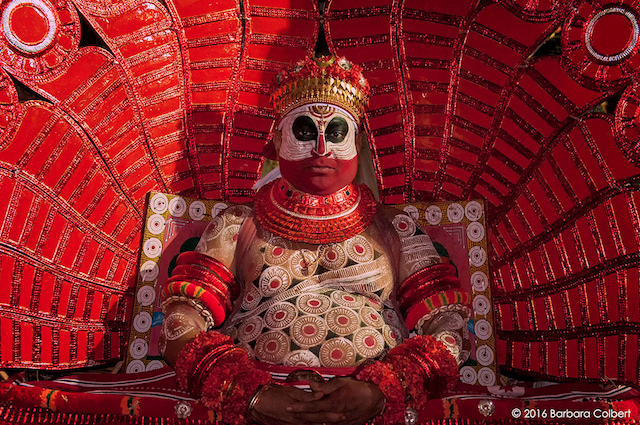
Photo � Barbara Colbert - All Rights Reserved Theyyam is also known as the �Dance of Gods�, which is unique to the folk culture of Kerala. The dance is an intriguing ritual integral to the worship of the goddess Kali. Originally reserved for the upper caste temple priests hundreds of years ago, it evolved to become a mass celebration for everyone. The 800-year old celebration has roots in the age-old Dravidian culture of South India, and is a combines dance, drama, music and mime. More than 1200 temples in the Malabar region of Kerala host these religious dances during the first three or four months of each year. The lower parts of the costumes in Theyyam are made of coconut leaves, while the upper part of the body remains bare and painted, although I have also seen some performers wearing two halves of a coconut shell as a bra. Usually, a paste of rice and turmeric is smeared on the upper bodies of the performers.  The Theyyam headdresses, made of bamboo, wood, peacock feathe...